
Understanding the Deployment Landscape
After watching teams struggle through botched deployments at 3 AM for the better part of a decade, I’ve come to appreciate that Kubernetes deployment strategies aren’t just theoretical constructs. They’re insurance policies against the kind of outages that make executives lose sleep and engineers question their career choices. The choice between rolling updates, blue-green deployments, and canary releases isn’t academic when you’re running services that process millions of transactions daily.
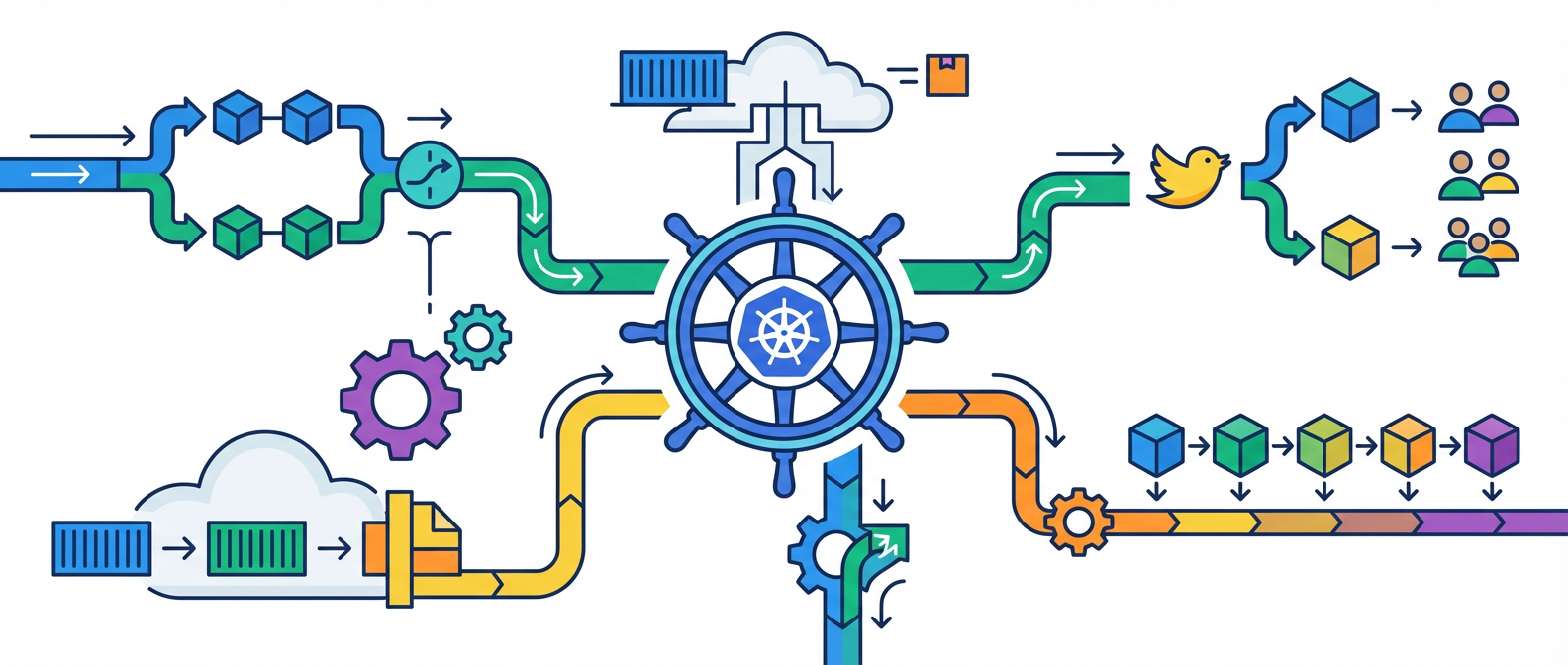
The real challenge is balancing three competing forces: deployment speed, risk mitigation, and resource efficiency. Rolling updates give you speed and efficiency but limited blast radius control. Blue-green deployments offer the cleanest rollback story but double your resource requirements. Canary deployments provide the most sophisticated risk management but require additional infrastructure complexity. Each strategy makes specific tradeoffs that align better with certain operational realities.
What I’ve learned is that successful production deployments start with honest conversations about your actual constraints. How much additional infrastructure can you afford to keep idle? What’s your mean time to detection for application-level issues? How quickly can your team respond to alerts during off-hours? These operational realities should drive your strategy selection more than architectural preferences or what worked at your last company.

Rolling Updates: The Default Choice That Needs Respect
Rolling updates are Kubernetes’ default deployment strategy, and there’s wisdom in that choice. The mechanism is elegantly simple: gradually replace old pod instances with new ones while maintaining service availability through load balancing. The deployment controller manages this process by creating new replica sets while scaling down old ones, respecting the maxUnavailable and maxSurge parameters you’ve configured.
Rolling updates shine because of their resource efficiency. You’re never running significantly more infrastructure than your steady-state requirements, which matters when you’re operating at scale or working within tight budget constraints. I’ve seen teams successfully run rolling updates for applications serving hundreds of thousands of users without major incident, provided they’ve done the foundational work around health checks and graceful shutdown handling.
However, rolling updates demand respect for their limitations. The gradual nature of the rollout means that problematic versions can affect real traffic before you detect issues. If your new version introduces a memory leak or breaks an important integration, some percentage of your users will experience that failure before your monitoring catches it. This is why proper readiness probes, comprehensive monitoring, and fast rollback procedures become non-negotiable with this strategy.
The configuration details matter more than many teams realize. Setting appropriate values for maxUnavailable and maxSurge requires understanding your application’s startup characteristics and resource requirements. A slow-starting application with high memory requirements needs different tuning than a lightweight service that reaches readiness in seconds. I’ve debugged deployment failures that traced back to surge settings that overwhelmed cluster capacity or unavailable thresholds that violated SLA requirements.
Blue-Green Deployments: When You Need the Nuclear Option
Blue-green deployments work on a completely different principle: maintain two identical production environments and switch traffic between them instantly. In Kubernetes, this typically means running parallel deployments and using service selectors or ingress configurations to direct traffic. The approach provides the cleanest possible rollback story since your previous version remains completely intact and ready for immediate reactivation.
The operational advantages become clear when you’re dealing with mission-critical applications or complex stateful workloads. Database migrations, schema changes, or applications with long startup times benefit enormously from the blue-green approach. You can fully validate the new environment under production conditions before directing any user traffic to it. When issues arise, rollback happens in seconds rather than minutes, which can be the difference between a minor incident and a major outage.
Resource requirements are the primary constraint for blue-green deployments. You’re effectively doubling your infrastructure footprint during deployment windows, which creates both cost and capacity implications. For resource-intensive applications or teams operating in constrained environments, this overhead can be prohibitive. I’ve worked with organizations where the blue-green resource requirements exceeded their cluster capacity, making the strategy technically impossible without significant infrastructure investment.
Implementation complexity also increases substantially with blue-green approaches. You need sophisticated traffic routing mechanisms, comprehensive environment validation procedures, and coordination between multiple system components. Database state synchronization becomes particularly challenging when dealing with stateful applications. The operational overhead of maintaining two production-grade environments simultaneously requires mature DevOps practices and experienced team members.
Canary Deployments: Sophisticated Risk Management
Canary deployments are the most nuanced approach to production rollouts, gradually exposing new versions to increasing percentages of production traffic while monitoring key metrics for signs of regression. This strategy provides the best balance between rapid feedback and limited blast radius, but requires sophisticated tooling and monitoring infrastructure to implement effectively.
The core insight behind canary deployments is that many production issues reveal themselves through subtle changes in application behavior rather than outright failures. Increased latency, higher error rates, or degraded user experience metrics often appear before complete service failures. By routing small percentages of traffic to new versions while continuously monitoring these indicators, you can detect problems early and halt rollouts before they affect significant user populations.
Successful canary implementations depend heavily on comprehensive observability infrastructure. You need real-time metrics collection, alerting systems that can detect subtle regressions, and automated rollback capabilities triggered by threshold violations. The tooling complexity increases dramatically compared to simpler deployment strategies. Service meshes like Istio or dedicated canary deployment tools like Flagger become essential infrastructure components rather than nice-to-have additions.
Traffic splitting mechanisms also require careful consideration. Simple percentage-based routing works for many scenarios, but sophisticated applications might need routing based on user attributes, geographic regions, or feature flags. The implementation details significantly impact both the effectiveness of your risk mitigation and the complexity of your operational procedures. I’ve seen teams struggle with canary deployments that worked perfectly in staging but failed to detect issues in production because of insufficient traffic routing sophistication.
Choosing Your Path Forward
The deployment strategy that works for your organization depends on your specific operational context, risk tolerance, and infrastructure constraints. Teams with mature monitoring and rapid incident response capabilities can often succeed with well-tuned rolling updates. Organizations with strict availability requirements and sufficient resources frequently benefit from blue-green approaches. Applications with complex behavior patterns and sophisticated DevOps teams may find canary deployments provide the optimal risk-reward balance.
The most important lesson I’ve learned is that deployment strategy selection isn’t a one-time decision. As your applications evolve, your team matures, and your infrastructure grows, the optimal approach may change. Start with the simplest strategy that meets your requirements, invest in the foundational capabilities that enable more sophisticated approaches, and evolve your practices as your operational context changes.
What deployment challenges have shaped your production experiences? I’m always interested in hearing how different teams navigate these tradeoffs in their specific operational contexts.