The Re:Invent Announcement That Landed Differently
Every December, AWS announces enough products and features to keep an engineering team busy until March. Most of it gets the appropriate attention, gets evaluated, gets shelved or adopted based on straightforward ROI calculations. But every few years, something lands that makes you sit back and think “okay, this one is different.” Aurora DSQL is that thing this cycle. Not because it’s flashy. Not because it has great marketing. Because it solves a problem that has haunted distributed systems architects for a decade: how do you actually run a single SQL database across multiple regions without accepting lag or architectural compromise.
I’ve watched the database world shift from monolithic Postgres instances to read replicas to managed Aurora clusters. Each transition solved something real but introduced new constraints. Read replicas give you scale on the read side, but now you’re managing replication lag in your application logic. Aurora clusters give you high availability within a region, but cross-region failover still means trade-offs on consistency or availability. Aurora DSQL changes the equation in a way that doesn’t feel incremental. This is a different approach to the problem entirely.
What Actually Changed in the Architecture
The core innovation here isn’t a marketing story. It’s a fundamental rethinking of how storage and compute relate to each other. Traditional Aurora, even today, couples storage and compute within a region. You get resilience across availability zones within that region, but going global requires read replicas or cross-region failover, both of which introduce operational friction. Aurora DSQL decouples storage from compute across availability zones and regions. That architectural separation is the load-bearing wall of everything else the system can do.
The database uses an optimistic concurrency model instead of the pessimistic locking you’d find in traditional Postgres. This sounds like a subtle detail until you’re running transactions across three regions simultaneously. Optimistic concurrency means the system lets concurrent operations proceed in parallel, then detects conflicts at commit time rather than blocking them upfront. In a distributed context, this is vastly more efficient. You’re not waiting for a global lock. You’re committing transactions at wire speed and handling the rare collision when it happens. The practical effect is that latency doesn’t spike when your workload crosses regional boundaries.
The numbers AWS published in late 2024 are worth examining closely. Internal benchmarks showed the system handling over one million transactions per second in multi-region configurations. That’s not theoretical math. That’s what they measured in a production-like test environment. If you’ve ever tried to scale Postgres across regions, you know that number would have seemed impossible a few years ago.
The Read Replica Lag Problem, Finally Addressed
Let me be direct about why this matters. If you run any service that serves global traffic, you’ve probably hit this scenario: a user in Singapore writes data, a user in London reads it thirty milliseconds later, and the read returns stale information. The usual response is to accept this and build your application around it. Some systems can’t live with that tradeoff. For those systems, you either accept massive complexity in your architecture or you don’t go global at all.
Cloudflare documented this problem in their own engineering blog when they were trying to scale their Postgres-backed services globally. They found that read replica lag could spike to 180 milliseconds under certain conditions, creating windows where distributed systems would see inconsistent state. This isn’t a Cloudflare problem. It’s a fundamental problem with the topology. When your replicas are thousands of miles away, latency is physics. Aurora DSQL sidesteps the problem by eliminating the replica concept entirely. There’s no source of truth in one region getting replicated to others. The data is distributed from the start.
That distinction matters because it changes what you can build. Certain classes of applications become feasible that weren’t before. Financial transactions across regions. Real-time collaborative tools serving a global user base. Global inventory systems where consistency actually matters. You’re no longer choosing between “accept eventual consistency” and “only serve one region.” You have a third option.
Why This Trend Is Bigger Than One Product
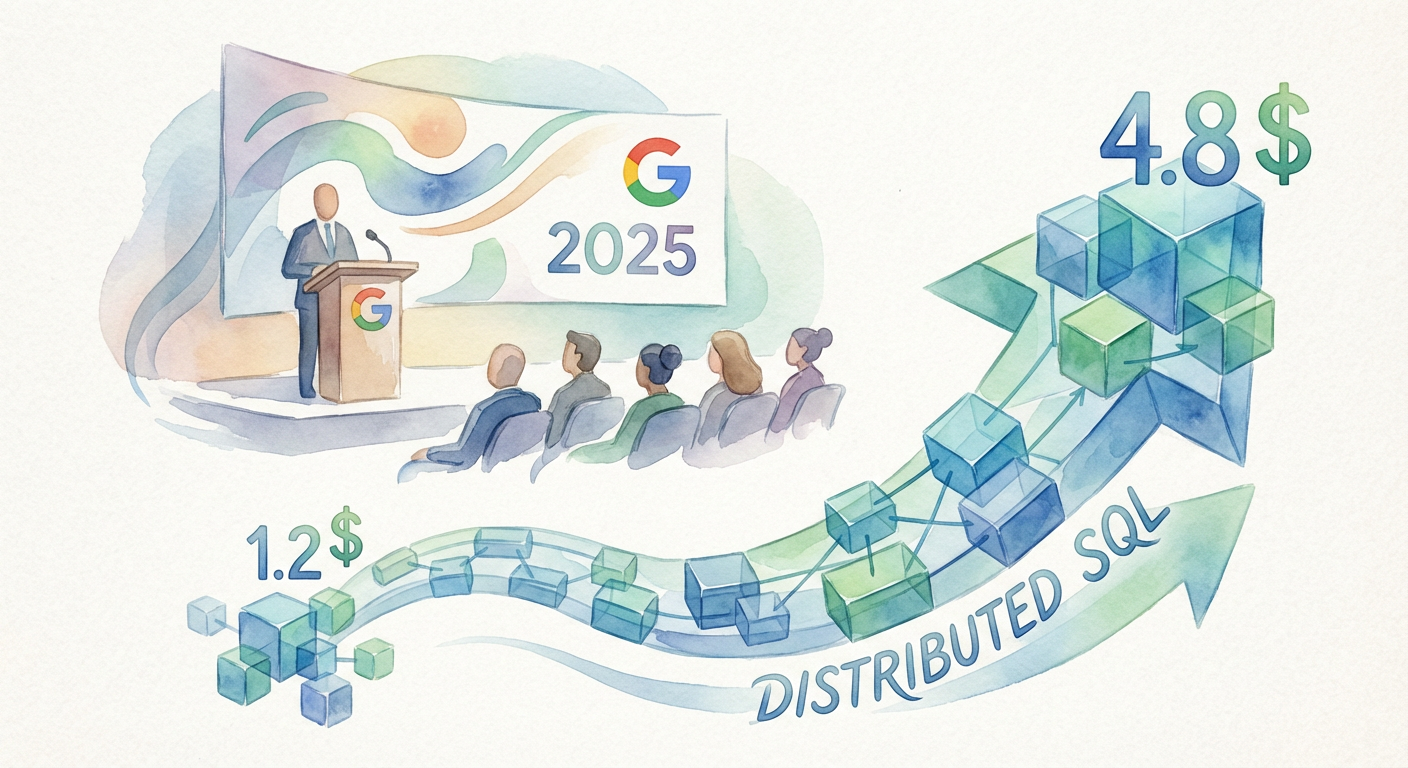
Aurora DSQL doesn’t exist in a vacuum. Gartner flagged distributed SQL as one of the top five infrastructure trends for 2025, and the analyst firm projects the market will grow from 1.2 billion dollars in 2024 to 4.8 billion by 2028. That trajectory tells you something about how the industry has been thinking about this problem. It’s not a niche. It’s a fundamental shift in what distributed systems need to look like.
The reason this shift is happening now is worth understanding. A few years ago, running distributed SQL systems was impractical for most organizations. You’d need specialized teams. You’d need deep expertise in distributed systems theory. Aurora DSQL, like other managed distributed SQL systems emerging in this space, abstracts that complexity away. You get the benefits of distributed architecture without needing to become an expert in Lamport timestamps and consensus algorithms. That’s a genuinely important development for the industry.
The Architecture Question You Actually Need to Ask
Here’s the honest assessment: this doesn’t replace everything. If your workload fits comfortably in a single region, Aurora DSQL isn’t the right answer. You’re paying for distributed capabilities you don’t need. The economics and simplicity of a regional Aurora cluster still make sense for plenty of applications. But if you’ve been stuck in a category of problems that traditional databases can’t solve well, this is worth taking seriously.
The practical path forward is to start with the AWS Aurora DSQL documentation and run some experiments with your actual workload patterns. Create a test harness that mimics your multi-region traffic. Run it against Aurora DSQL. Run the same test against your current architecture. That’s the only evaluation that actually matters. Benchmarks are useful context, but they’re not your workload.
I’ve been in the database trenches long enough to be skeptical of silver bullets. Aurora DSQL isn’t that. But it’s a thoughtful solution to a real problem that has forced a lot of distributed systems into awkward architectural shapes. If you’re designing a new system that needs to serve global traffic with strong consistency guarantees, you’d be making a mistake not to evaluate it. Have you run into the read replica lag problem in your own systems? What architecture did you eventually settle on? I’d genuinely like to hear what’s worked and what hasn’t in your specific context.